Application solution / Outdoor Durability

Keep field identification readable across seasons and service visits.

Specify the location and exposure as well as the intended life. Match the adhesive, film and print protection to the actual equipment installation.

Start with the question

How long must the information remain usable in the field?
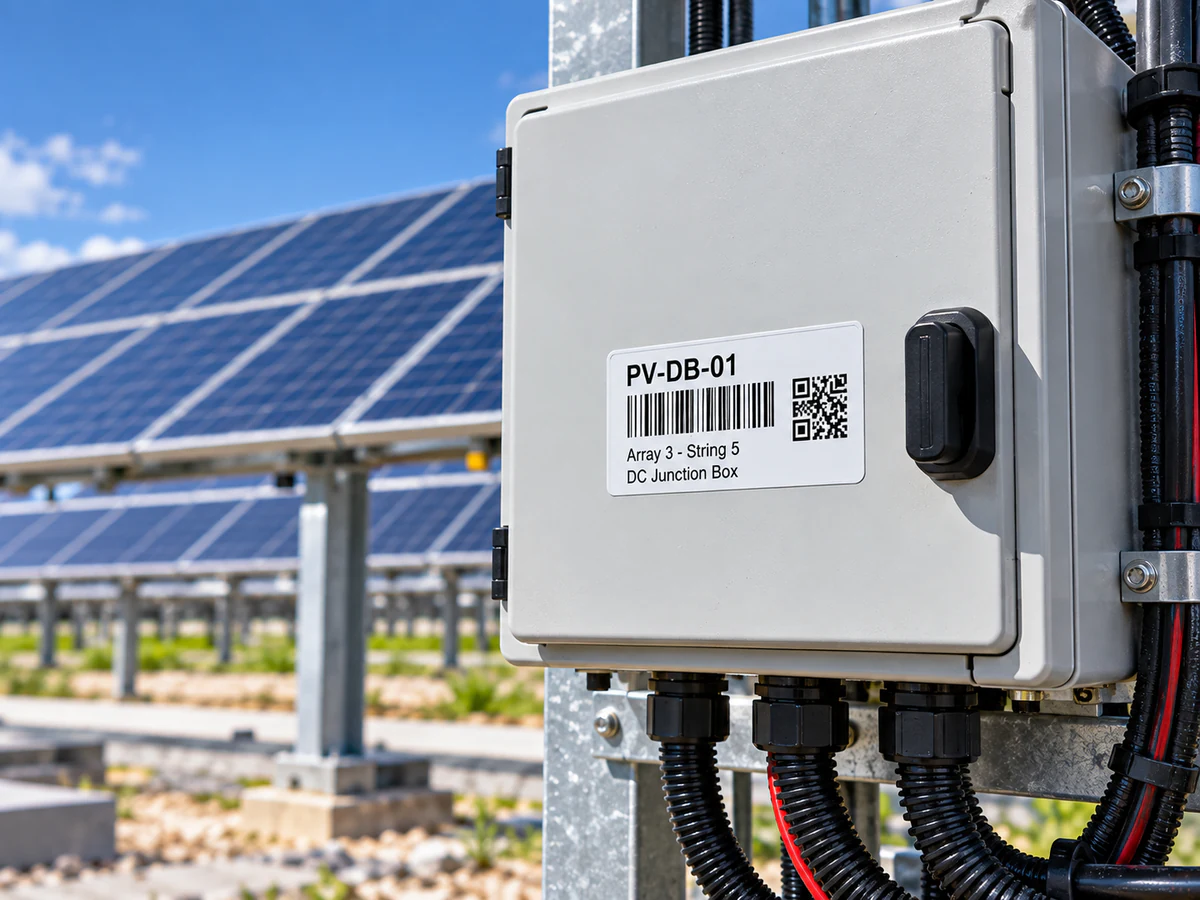
Adhesive equipment identifier on an outdoor enclosure beside solar panels.

02 / The application challenge

What must the label withstand?

Outdoor identification is exposed unevenly: a sheltered cabinet door and a sun-facing panel may have very different requirements. Weather, cleaning and maintenance all affect the information that a technician needs to find years later.

Climate and orientation

Record the installation region, sun exposure, panel orientation and shelter. UV intensity and moisture patterns inform construction selection.

Surface and application

Review powder-coated or painted metal, stainless steel and plastics. Document surface preparation and application temperature.

Print life

Choose contrast, colors and protection around the information that must remain readable. Assess barcode scanning as well as visual text.

Service and wear

Include cleaning agents, oils, abrasive handling and temperature cycling through the expected maintenance life.

03 / Recommended approach
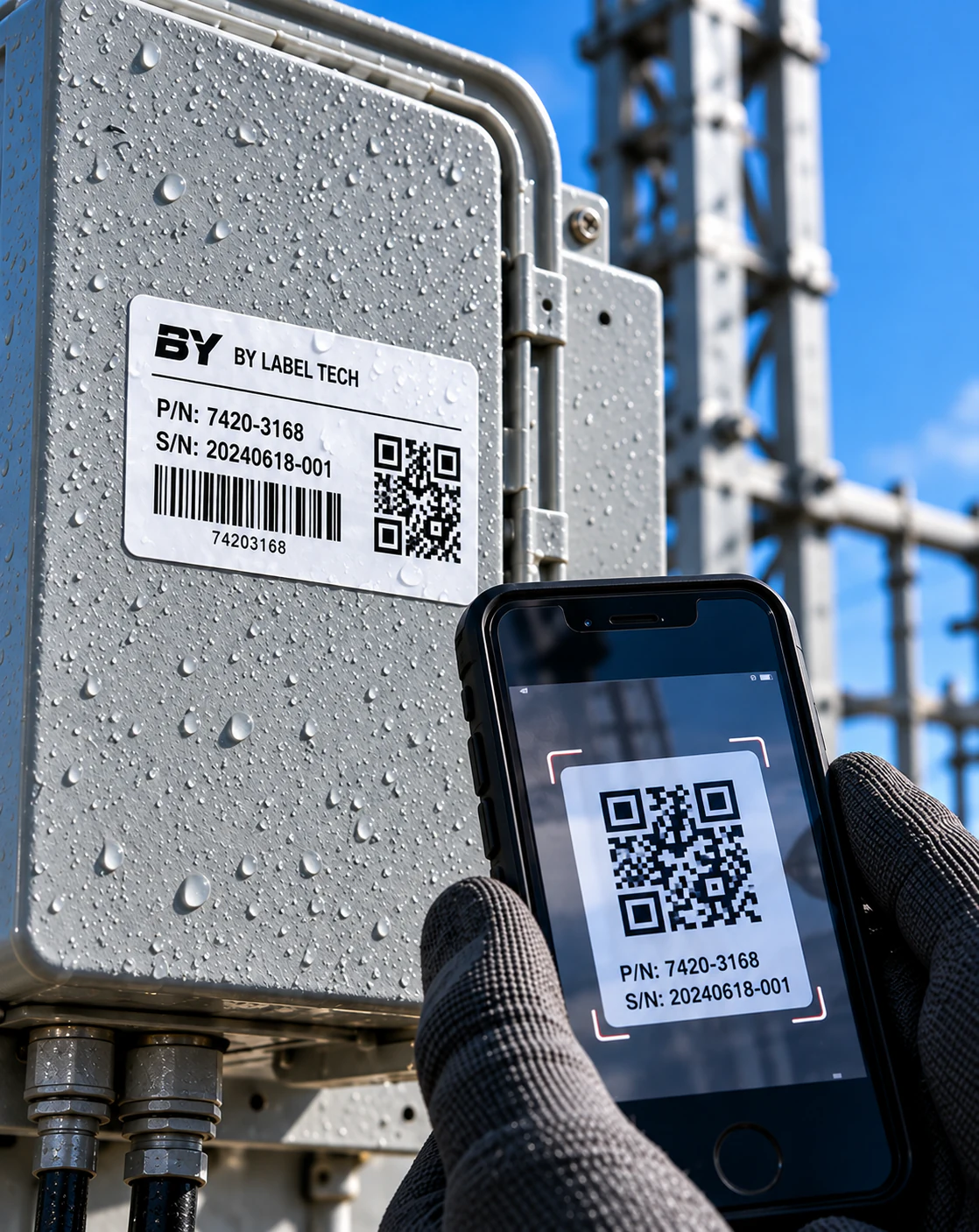
Match the approach to the application.

Scanning an adhesive asset identifier on installed outdoor equipment.

Consider the installed orientation, weather exposure and access for reading.

  • Outdoor electrical cabinets and control enclosures
  • Renewable-energy and field equipment
  • Machinery and fixed industrial assets
  • Service, warning and model / rating identification outdoors

Model / rating information, warnings, serial numbers, asset numbers and barcode / QR / Data Matrix can share a durable field identifier. Consider viewing distance, glare, code size and maintenance access when laying out the finished label.

04 / Construction & technical options

Select the complete printed construction.

Durable equipment identification

PET / polyester and metallized polyester with permanent acrylic or high-tack adhesion for suitable equipment surfaces.

Conformable outdoor graphics

PVC / vinyl and specialty durable films evaluated around surface geometry, weather exposure and required information.

Protected print system

A compatible overlaminate or protective construction for print durability, with PC / polycarbonate options for relevant industrial graphics.

Available options apply to selected constructions. Confirm the material, adhesive, print system, substrate and exposure together before specifying a finished label.

Outdoor life tiers
  • Available tiers include 1 year+, 3 years+, 5 years+ and selected constructions approximately 8–10 years.
  • Actual life depends on construction, climate, orientation, UV intensity, substrate and chemical exposure; these tiers are not a universal guarantee.
Exposure options
  • UV, weather, moisture, abrasion, oils, cleaners and temperature cycling.
Adhesives
  • Permanent acrylic, high-tack, low-surface-energy and application-specific systems to address bond and edge lifting.
Thermal class
  • Selected durable industrial constructions around −40°C to +150°C; select the outdoor-life and temperature requirements together.
Protection and print
  • Protective laminate / overlaminate, custom colors and digital or screen-printed graphics where appropriate.
Finished formats
  • Rolls, sheets, individual pieces and custom die-cut equipment labels.

Compliance and marking requirements

  • UL-recognized, UL 969 related and cUL / CSA label options are selected around the required market, substrate, print system and outdoor conditions.
  • CE, ETL and GS / TÜV marking-label applications can be supported with authorized artwork. Printing a mark does not certify the equipment or establish a label-construction approval.

05 / Selection & validation

Evaluate the label in its real conditions.

Agree the intended outdoor-life tier and its supporting evidence for the installation. Evaluate adhesion and readable print on the actual surface with the relevant weather, cleaning and handling conditions before accepting the construction.

06 / Discuss your application

Start with your application.

Tell us what needs identifying and where the label will be used. A short description or drawing is enough to begin.

Helpful application details, when available
  • Installation region, climate and orientation
  • Substrate, coating and surface preparation
  • Application and service temperature
  • UV, moisture, cleaning and abrasion
  • Expected service life and inspection interval
  • Dimensions, quantity, artwork and code data
  • Required markings and supply format