Resources
Better questions. Better label specifications.
Practical selection notes for engineers and technical buyers. Use these starting points with the detailed Product, Solution and Industry pages to prepare an application-specific brief.
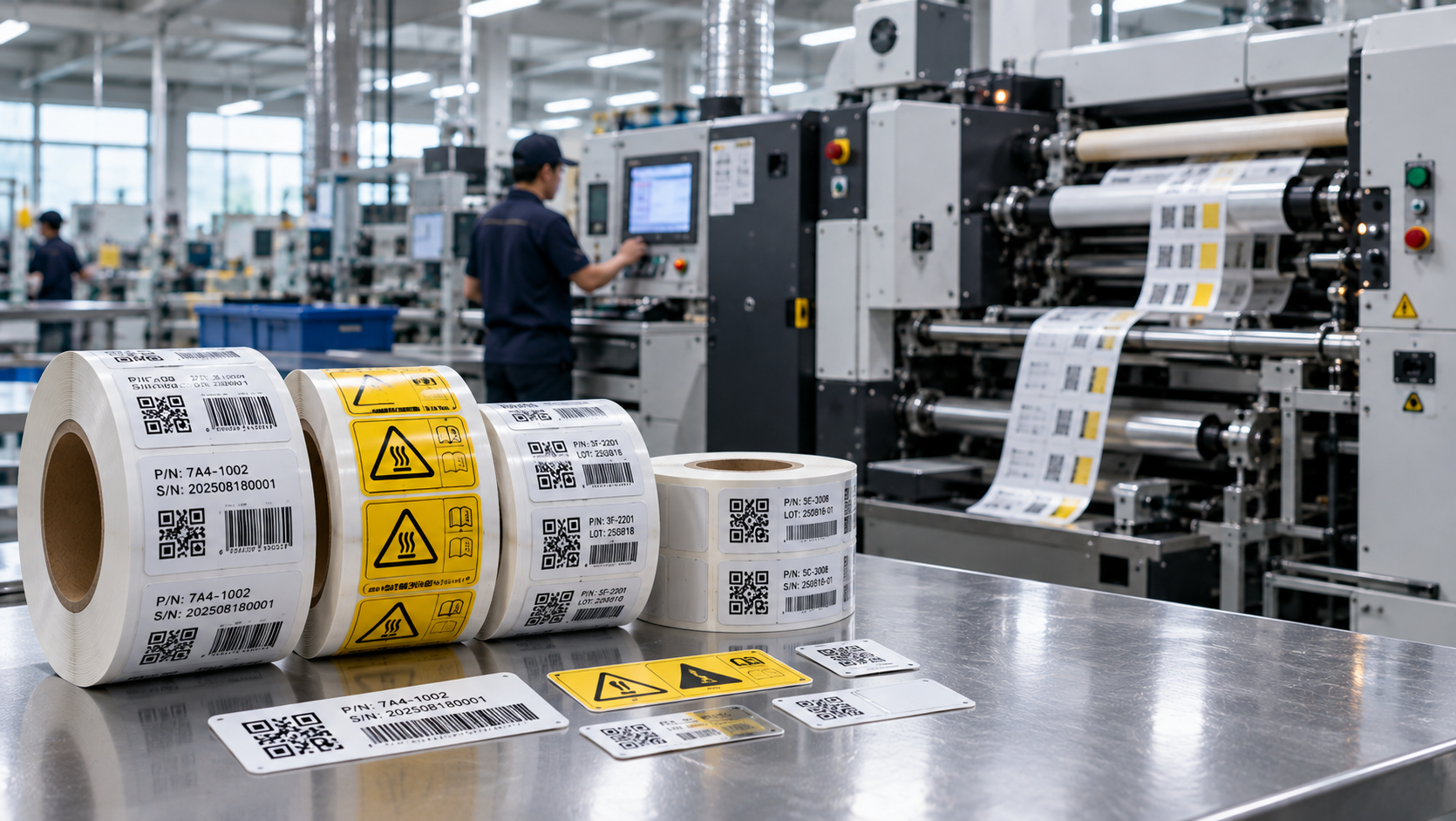
In-depth application guides
From a selection question to a practical decision.
Explore focused guides for cable identification, PCB processes, chemicals, tamper evidence and outdoor service.
Selection library
Choose a question.
Practical selection note
How to specify a label for a high-temperature process
Start with the temperature-time profile and labeling stage, then evaluate the complete printed construction.
- Record the peak, time at temperature, number of passes and cooling stages. Distinguish a brief process exposure from continuous service; the same numerical peak does not describe both.
- Identify the substrate, flux or cleaner contact, and when the label is applied. Evaluate attachment, dimensional stability and code readability after the full sequence rather than inspecting unused material alone.
- The approved capability classes are described on the linked Product and Solution pages. Select one construction against the actual profile instead of combining separate classes into one range.
Practical selection note
Choosing a cable identification format
Use diameter, jacket, movement and reading access to compare wrap, flag and self-laminating constructions.
- Measure outside diameter, available straight length and routing clearance. A wrap needs adequate overlap; a flag needs enough space to remain readable without snagging.
- Identify the jacket compound and application conditions. Evaluate representative cables after dwell, flexing and the expected fluids or abrasion.
- Define the circuit text and code before choosing dimensions. Verify readability at the installed orientation, not only on the bench.
Practical selection note
PET vs PI: choose around the process
Film name alone does not specify adhesive, print durability or process compatibility.
- Separate labels applied before thermal processing from those applied afterwards. PI process constructions and PET service constructions answer different application briefs.
- Review adhesive, coating, print system and any protective layer together. A change in one layer can alter the suitability of the finished construction.
- Use the actual surface, temperature profile and chemical sequence to compare samples. Keep the resulting approval tied to the evaluated construction rather than to the generic film name.
Practical selection note
Surface and adhesive selection: what to record
Describe the production surface and application conditions before selecting an adhesive system.
- Record the substrate, coating, texture, curvature and preparation method. “Plastic” or “painted metal” is rarely enough detail to reproduce an adhesion evaluation.
- Consider contamination, application temperature, pressure and dwell before use. Evaluate the actual finish and any realistic variation between production lots.
- Compare permanent acrylic, high-tack, low-surface-energy or removable options against the intended outcome. For removable labels, include removal timing and acceptable residue in the brief.
Practical selection note
What determines outdoor label durability?
Construction, exposure and readability criteria determine how a requested service period should be evaluated.
- Specify climate, orientation, shelter, moisture, cleaners and substrate. Direct sunlight on an enclosure and a sheltered cable run represent different exposures.
- Separate attachment from readability in the acceptance criteria. Include print contrast, edge retention and any laminate condition that affects use.
- Outdoor tiers on the linked pages apply to selected constructions and conditions. Confirm supporting documentation and the intended environment before choosing a service-life tier.
Practical selection note
How to brief a chemical-resistant label
Name the chemical and exposure sequence; a broad resistance label is not a test specification.
- Record the fluid identity, concentration, temperature, contact duration and frequency. Distinguish a splash from immersion or repeated wiping.
- Describe cleaning pressure, abrasive contact and whether exposure happens before or after heating. Combined stresses can require a different evaluation from separate exposures.
- Inspect the complete printed sample on the real substrate. Agree what counts as failure: lifting, residue, unreadable text, loss of scan performance or another application outcome.
Practical selection note
Barcode, QR or Data Matrix for industrial traceability?
Choose a code around the data, available space and reading system, then validate it in the application.
- Define the data payload and whether the label holds a permanent identifier or a link to a maintained record. Assign responsibility for uniqueness, revisions and replacement labels.
- Compare the available area with the production scanner, print resolution, reading distance and angle. Include quiet space and a human-readable fallback in the artwork review.
- Test actual printed labels before and after exposure. A code that reads on a flat proof may not read reliably on a curved cable, reflective housing or obscured assembly.
Practical selection note
VOID and destructible label constructions
Define the evidence needed after removal and evaluate it on the intended surface.
- Decide whether the required indication is a transferred pattern, a changed label appearance or film fragmentation. These outcomes need different constructions.
- Record surface finish, bonded area, seam geometry and time between application and possible opening. Inspect the evidence after removal at realistic conditions.
- Treat tamper evidence as an indication of interference, not a guarantee that access is prevented. Approve the visible outcome and any residue against the application requirements.
Practical selection note
What to include in an industrial label quotation brief
Give enough application detail to select a construction while leaving unknowns clearly identified.
- Start with the end use, substrate, size and estimated quantity. Mark unknowns as “to be confirmed” rather than guessing a specification.
- Add temperature, chemicals, outdoor exposure, service life and the identification content. Include any required approval or customer specification.
- Record artwork availability and the desired roll, sheet or piece format. Use the local quote brief to collect these details; it downloads a file and does not send an inquiry.
Practical selection note
Questions to ask about UL-related label options
Keep construction documentation, print combination and equipment marking authorization distinct.
- Identify the actual end use and required category before requesting a construction. Equipment marking systems and limited-use cord-label applications do not have identical scope.
- Ask which substrate, adhesive, print combination and exposure conditions the documentation covers. A generic material name or a printed approval mark is not enough to establish suitability.
- Keep equipment artwork approval separate from label construction selection. Review the project-specific documentation before production; no company-wide certification is implied by an available construction option.
From guidance to your application
Turn the unknowns into a clear brief.
Record what is known and flag what needs evaluation. The quote brief brings the surface, process, identification and supply details together.
Get a Quote