Application solution / Cable Identification

Keep every cable and harness identifiable through assembly and service.

Cable identification starts with the jacket, diameter and installed position. Build a readable identifier that stays usable through routing, flexing and maintenance.

Start with the question

Can the installer find and read the right cable after routing?
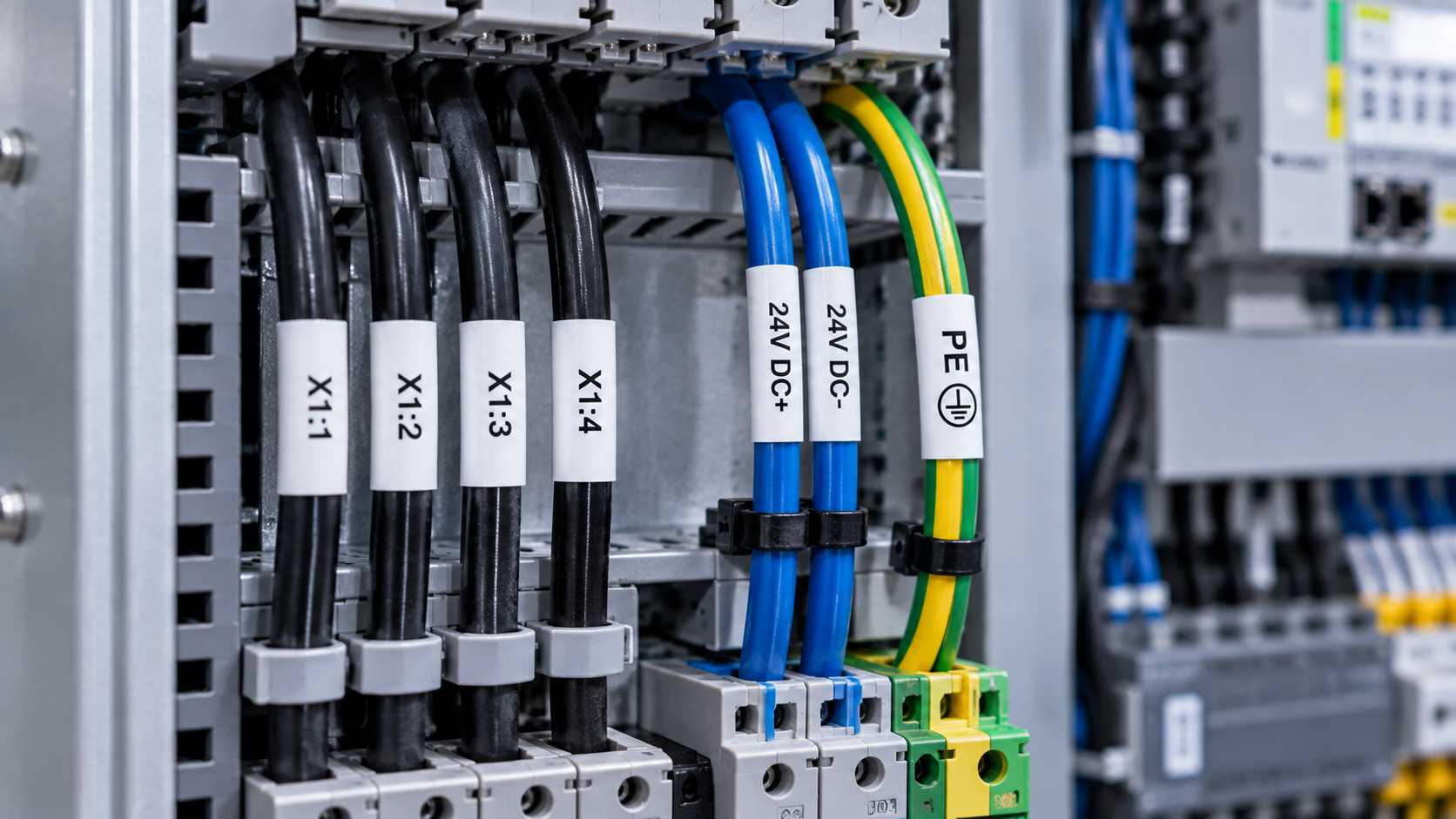
White wire identification markers on black, blue, and green-yellow conductors in an electrical enclosure

02 / The application challenge

What must the label withstand?

Small diameters, tight bends and closely packed assemblies leave limited space for information. A label must suit the cable geometry and jacket while keeping the identifier visible in the installed orientation.

Diameter and bend radius

Measure cable diameter and the installed bend. Choose wrap length or flag dimensions that provide usable print area without obstructing the assembly.

Jacket and surface energy

Identify the insulation material, texture and condition. Adhesive selection must account for the jacket rather than diameter alone.

Flexing and installation

Record whether identification is applied before routing, during assembly or after installation. Check rubbing, repeated flexing and access for application.

Environment and lifespan

Separate cabinet service from outdoor or under-hood exposure. Include oils, moisture, abrasion, UV and the expected maintenance period.

03 / Recommended approach
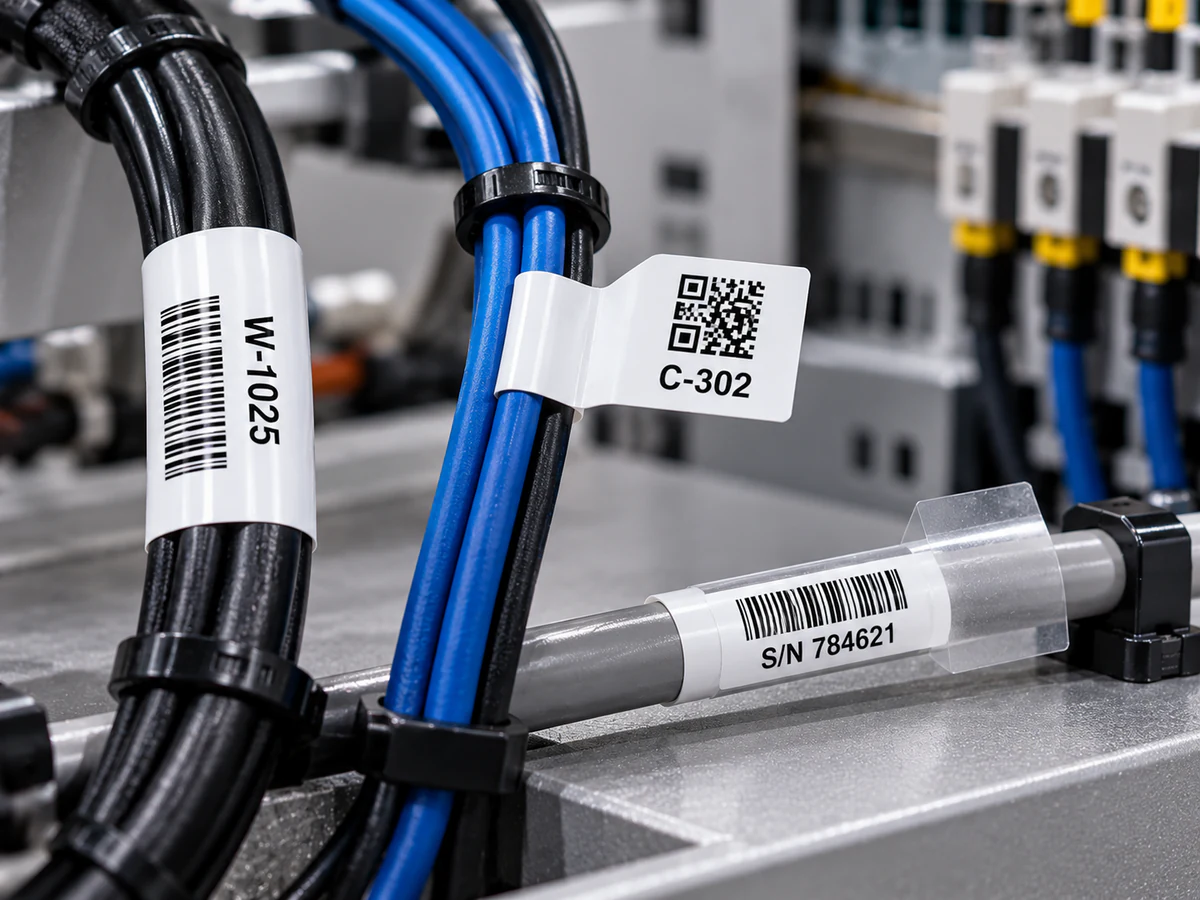
Match the approach to the application.

Wrap-around and flag identification labels on cable samples.

Wrap and flag formats offer different reading positions on a cable assembly.

  • Wire harness manufacturing and cable assemblies
  • Electrical cabinets and control panels
  • Industrial automation and automotive / electrical assemblies
  • Power cables and industrial cable installation

Combine wire and harness IDs with barcode, QR code, Data Matrix, serial numbers or sequential numbering. Match character size and code orientation to the installed viewing position. Thermal-transfer-compatible constructions and finished variable-data printing support project-specific identification formats.

04 / Construction & technical options

Select the complete printed construction.

Wrap-around / self-laminating

Printed identification with a wrap or clear protective area, sized to the cable and available application length.

Flag-style identification

A projecting information area for assemblies where the cable circumference cannot provide a readable code area.

Demanding harness applications

PET, PVC / vinyl, nylon and specialty PI cable or harness labels selected around heat, movement and jacket compatibility.

Available options apply to selected constructions. Confirm the material, adhesive, print system, substrate and exposure together before specifying a finished label.

Construction formats
  • Wrap-around, flag-style, self-laminating, cable ID and harness ID labels with custom die-cut dimensions.
Thermal classes
  • Approximately −40°C to +150°C for selected durable / flame-retardant constructions.
  • Higher-temperature PI options where required; establish exposure duration and the jacket limitation separately.
Adhesion
  • Permanent acrylic, high-tack and application-specific systems for the jacket, including relevant low-surface-energy options.
Durability
  • Oil, moisture, abrasion and UV resistance; protective wrap and resistance to edge lifting.
Material options
  • PET / polyester, PVC / vinyl, nylon and specialty PI constructions.
  • Flame-retardant and halogen-free choices are separate construction options; specify which is required.
Supply format
  • Rolls, sheets, individual pieces and custom die-cut harness identification sets.

Compliance and marking requirements

  • Selected UL94 V-0 / VTM-0 flame-retardant, RoHS, REACH and halogen-free options are available with construction-specific evidence.
  • PGIS2 related options apply only where the relevant end-product application is covered. For flag and wrap-around labels, establish the applicable cord-label / end-product requirements rather than assuming a general UL 969 option covers the application.

05 / Selection & validation

Evaluate the label in its real conditions.

Apply samples to representative cable jackets and diameters. Evaluate the installed bend, flexing and handling sequence, then check edge lift, adhesion and readability after the required temperature and fluid exposures.

06 / Discuss your application

Start with your application.

Tell us what needs identifying and where the label will be used. A short description or drawing is enough to begin.

Helpful application details, when available
  • Cable diameter, jacket and bend radius
  • Harness / cabinet location and installation method
  • Flexing, oil, moisture, abrasion and UV exposure
  • Temperature class and expected lifespan
  • Label dimensions, quantity and supply format
  • Wire IDs, codes, variable data and artwork
  • Flame / halogen-free and other compliance needs